79th Anniversary of the Kielce Pogrom
Postwar Poland was a space of profound transformation and tension. The country was under strong influence from the Soviet Union, and the new system of power relied on mechanisms of violence, control, and indoctrination. At the same time, Jews returning from extermination camps and Jewish repatriates often encountered social hostility—driven in part by fear of losing illegally seized property, but also by deeply rooted stereotypes and resentments.
Antisemitism, which before the war had strong religious and social foundations, survived the occupation and took on new forms. In postwar discourse, Jews were often accused of alleged ties to the communist regime (“Żydokomuna”), which deepened public animosity and created fertile ground for the escalation of violence.
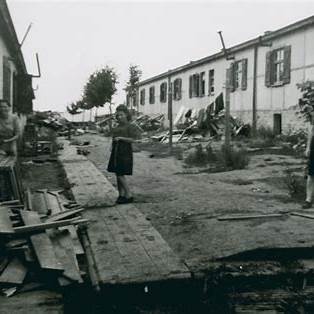
The ruins and destruction at the building on Planty Street – the residence of Holocaust survivors and the headquarters of local Jewish institutions, which fell victim to the pogrom.
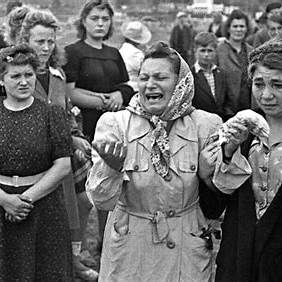
Women mourning the dead – scenes of grief and sorrow following the pogrom.
The immediate cause of the pogrom was a rumor about an alleged ritual murder. A missing 9-year-old boy, Henryk Błaszczyk, upon returning home, claimed that he had been held captive by Jews. This false information was quickly picked up by local residents as well as officers of the militia and the Security Office (UB). On July 4, a crowd—reinforced by soldiers and militiamen—stormed the building of the Jewish Committee at 7/9 Planty Street in Kielce. A brutal assault followed, during which victims were beaten, tortured, and killed—even in the hospital and on the city streets.
The significant involvement of state officials in the pogrom raises serious concerns about their role. Instead of suppressing the violence, they often actively participated in it. This fact has fueled numerous hypotheses suggesting that the security services may have played a role in provoking the events.
The pogrom was condemned by the authorities of the People’s Republic of Poland as well as by international actors, including the United States, the United Kingdom, and the World Jewish Congress. In response, swift show trials were held, resulting in nine people being sentenced to death, with the sentences carried out immediately. Although the regime formally denounced the pogrom, its response also served a propaganda purpose—aimed at portraying the violence as the work of “reactionary elements” and “enemies of the people’s government.”
The most serious consequence of the events, however, was the wave of Jewish emigration. The Kielce pogrom convinced many survivors that Poland was not a safe place to continue their lives. It is estimated that by 1949, around 100,000 Jews left the country—this was the largest postwar emigration of the Jewish community.
The Kielce pogrom has become the subject of numerous interpretive controversies. Some historians—such as Jan Tomasz Gross—emphasize the role of deeply rooted antisemitism in Polish society as the main cause of the events. Others, like Piotr Gontarczyk, suggest the possibility of a provocation by communist security services, aimed at consolidating power by triggering a societal shock.
Contemporary historiography increasingly moves away from binary interpretations, highlighting the complexity of the situation: the interaction of social sentiments, political calculations, structural violence, and local mechanisms of contempt. The pogrom is now seen as the result of intertwined psychological, ideological, and systemic factors.
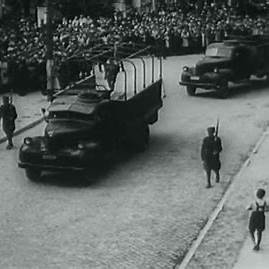
Crowd and funeral columns – the mourning procession, transport of coffins, and participants in the funeral of the pogrom victims.
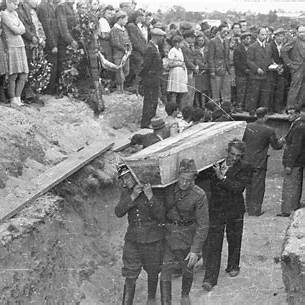
Coffins being carried to the cemetery.
For decades, the Kielce pogrom was a silenced or manipulated topic in the official discourse of the People’s Republic of Poland. Only the political transformations of the 1990s made open research and public debate possible. In 1996, President Aleksander Kwaśniewski officially apologized for the events of 1946, and Kielce became the site of recurring commemorations honoring the victims.
Today, the memory of the pogrom is preserved through the work of institutions such as the Museum of the Dialogue of Cultures in Kielce, as well as through memorials, educational programs, and academic research. The topic is also present in literature, film, and theater, becoming a symbol of the need to confront a difficult past.
Bibliography:
- Blatman, D. (2001). The Death Marches: The Final Phase of Nazi Genocide. Harvard University Press.
- Engel, D. (1998). Patterns of Anti-Jewish Violence in Poland, 1944–1946. Yad Vashem Studies, 26, 43–85.
- Gontarczyk, P. (2000). Pogrom? Czy prowokacja? Fronda.
- Grabowski, J. (2011). Judenjagd: Polowanie na Żydów 1942–1945. Wydawnictwo Czarne.
- Gross, J. T. (2008). Fear: Anti-Semitism in Poland after Auschwitz. Princeton University Press.
- Libionka, D., & Skibiński, P. (2004). Akta sprawy karnej przeciwko sprawcom pogromu ludności żydowskiej w Kielcach 4 VII 1946. IPN.
- Michlic, J. B. (2006). Poland’s Threatening Other: The Image of the Jew from 1880 to the Present. University of Nebraska Press.
- Polonsky, A. (2012). The Jews in Poland and Russia: Volume III: 1914 to 2008. Littman Library of Jewish Civilization.
- Śpiewak, P. (2017). Pogrom Żydów w Kielcach 4 lipca 1946. Czerwone i Czarne.
- Tomaszewski, I. (1999). Żydzi w Polsce po II wojnie światowej: materiały z sesji naukowej. Instytut Historyczny UW.
The Ponary Massacre – The Tragedy of Lithuanian Jews
Preparations and Early Stages of Implementation
Vilnius was occupied by the Wehrmacht on June 25, 1941, just a few days after Nazi Germany launched its invasion of the Soviet Union. Almost immediately, efforts began to organize a new administration subordinate to the Germans. The city, along with the entirety of Lithuania, became part of the Reichskommissariat Ostland, which also included Estonia, Latvia, western parts of present-day Belarus, and portions of what is now Poland’s Podlaskie Voivodeship.
At the same time, a crackdown on both real and perceived opposition began. Units of the German security forces entered the city, rounding up Jews, communist activists, and individuals considered dangerous to German rule in Lithuania.
The restrictions on the rights of the Jewish population advanced rapidly, and soon they were confined to ghettos. Jewish individuals were stripped of their jobs and required to wear armbands bearing the Star of David for identification. Ponary, located about ten kilometers from Vilnius, was chosen as the site of extermination. Before the Eastern Front was opened by the Third Reich, the Soviets had begun constructing aviation fuel storage facilities there. However, the work was never completed. As a result, a number of deep, concrete-lined pits remained—later repurposed by the Germans as mass graves for storing corpses.
The Nazis, however, were unwilling to carry out the killings with their own hands. Instead, they enlisted a collaborationist police unit called Ypatingasis būrys (Lithuanian for “Special Squad”). It was composed primarily of Lithuanians, but also included a few Russians and Poles. Leadership positions were held by German officers. Members of the organization were, at least in part, shaped through indoctrination—especially since some were recruited before the age of 16. During the three years of German occupation, the unit is estimated to have killed between 80,000 and 100,000 people.
Course and Commemoration
The Ponary massacre began in early July 1941. The first victims were Jewish men, who were forced to march on foot from Vilnius to the site of the camp. From more distant locations—including other Lithuanian cities and areas of occupied Poland—victims were brought by truck and train transports. For hours, and sometimes even days, they had to wait for death in extremely harsh conditions. Executions were carried out using rifles or machine guns. The bodies were thrown into concrete-lined pits and covered with layers of soil.
The most tragic events in Ponary occurred on September 2, 1941. Following a German provocation a few days earlier, the Nazis conducted large-scale roundups and brought nearly 4,000 Jews to the camp, including 2,019 women and 817 children. Death awaited them all. Over the following months, more executions were carried out, and in total more than 80,000 people were killed. In addition to the Jewish population, the victims included several thousand Soviet POWs, approximately 2,000 Poles, and several dozen Roma. Some prisoners managed to escape on the way to Ponary, and later a number of them were rescued by local residents.
Shortly before the Soviet army entered Vilnius in 1944, Nazi officials began efforts to cover up the traces of their crimes. The victims’ bodies were exhumed and burned, and attempts were made to destroy any existing documentation. In the postwar years, many of the perpetrators were sentenced to death or life imprisonment. Some, however, managed to evade justice.
The memory of their victims has endured. Their tragedy is commemorated today, among other ways, through the poem Ponary Lullaby by Noah Wolkowski, a Jewish poet from Vilnius. In the poet’s words:
“Here graves are growing. Enemies planted them, look – the buds are visible now. All roads now lead to Ponary, none return.”